
It's the call every family dreads: the scheduled caregiver hasn't arrived, and your parent is alone. Maybe it's flu season, a snowstorm, or a family emergency on the caregiver's end. Whatever the cause, the question that matters most isn't whether it will ever happen (in an industry facing real staffing pressure, it can) but what happens in the next fifteen minutes.
The difference between a stressful hiccup and a genuine crisis usually comes down to one thing: whether the agency behind your care had a plan before the gap ever occurred.
Why staffing gaps happen at all
Home care doesn't operate in a vacuum. Canada's health care sector has been under real strain: personal support worker job vacancies reached 30,800 positions in 2022–2023, making up more than a quarter of all health care job vacancies nationally (CIHI). Labour market projections for home support workers and caregivers show demand consistently outpacing supply through the 2021–2023 period (ESDC/COPS).
This shortage touches every setting, including long-term care homes, which typically respond to gaps with extra hours from existing staff, schedule adjustments, and contract staffing (CIHI). The takeaway isn't that home care is unreliable. It's that reliability has to be engineered deliberately, not assumed. A family choosing a home care agency is really choosing a system for handling the day something goes wrong.
What a well-run agency actually does when a shift is at risk
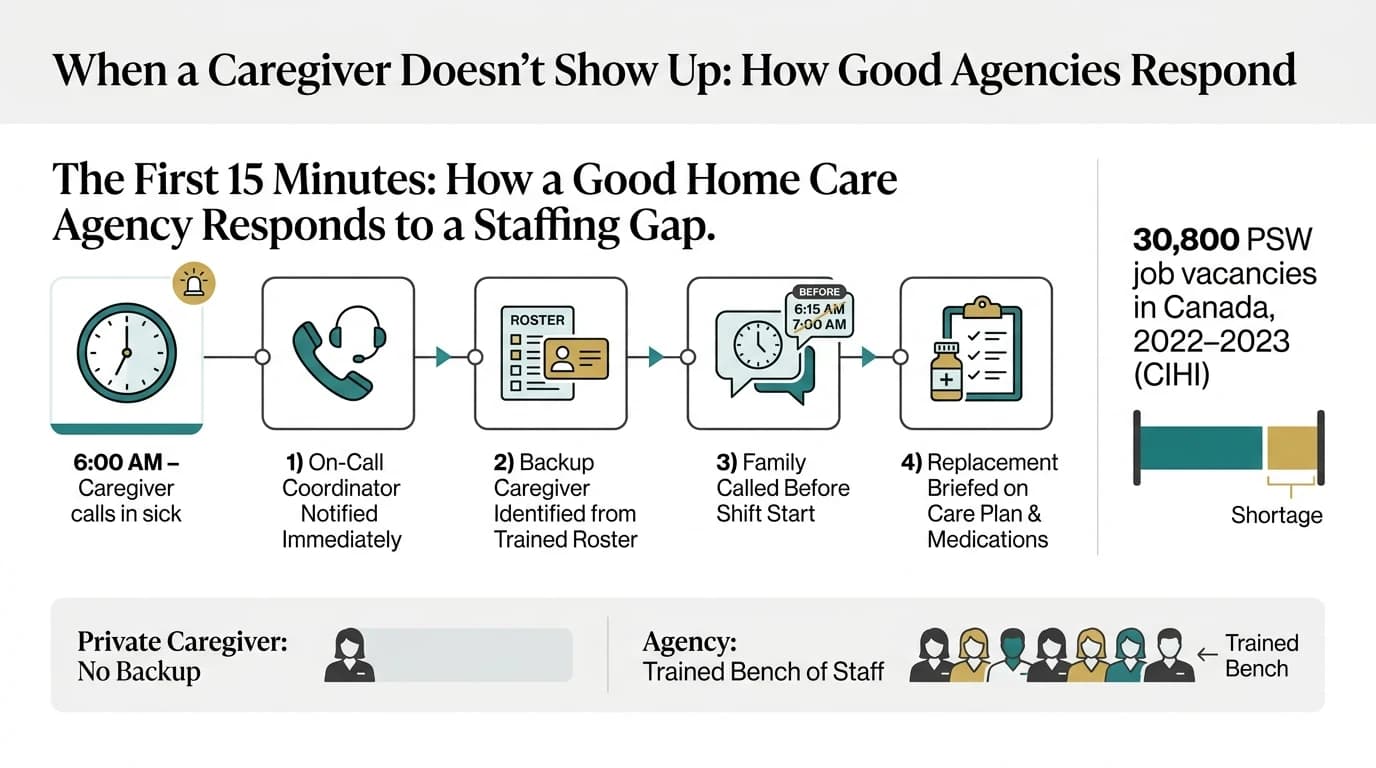
In practice, families rarely see the machinery behind a smooth home care experience, because it's built to be invisible. A caregiver calling in sick at 6 a.m. should trigger a fairly predictable sequence:
- An on-call coordinator is notified immediately, not left to voicemail until the office opens.
- A qualified backup caregiver is identified from a roster already familiar with the client's needs, ideally someone who has worked with that client before or has reviewed their care plan.
- The family is called before the shift start time, not after, so there's no gap in awareness even if there's a short gap in coverage.
- The replacement caregiver is briefed on medications, routines, mobility needs, and any safety considerations before walking in the door.
A caregiver will typically carry a printed or digital copy of the client's care summary specifically so that if they're new to that household, they aren't starting from zero. This is where an agency's internal roster depth matters far more than its marketing does. A single-caregiver private arrangement has no backup by definition; an agency with a bench of trained staff does.
The role of a documented care plan
A detailed, current care plan is one of the most underrated tools in continuity of care. When a primary caregiver becomes unavailable due to illness or emergency, a documented plan lets someone else step in without guesswork, provided it identifies alternate caregivers and keeps key details accessible (Family Caregivers BC). This matters even more for clients with complex needs, such as those receiving in-home nursing care or recovering from a stroke, where medication timing, transfer techniques, or speech therapy exercises need to be followed precisely.
For families managing stroke recovery at home, ask specifically how the agency documents therapy goals and daily routines so a substitute caregiver can pick up mid-plan without your parent losing a day of progress.
Questions to ask before you sign, not after a problem
The best time to understand an agency's backup process is during your first conversation, not during a crisis. Ask directly:
- What is your process if my regular caregiver can't make it?
- How quickly do you typically fill an unexpected gap?
- Will I be called before the shift, or after?
- Do backup caregivers receive my parent's care notes in advance?
- Is there a supervisor or care coordinator I can reach directly, any time?
Vague answers are a warning sign. A confident, specific answer, ideally naming an actual on-call system or coordinator role, tells you the agency has thought this through long before you asked. This is also a good moment to compare a private caregiver against an agency model, since private arrangements versus agency care differ enormously in exactly this respect.
Trust is built before the emergency, not during it
Families often tell us that what they wanted most wasn't a guarantee that nothing would ever go wrong. It was confidence that if something did, they wouldn't be the ones scrambling to fix it. That confidence comes from transparency: knowing who to call, knowing a real plan exists, and knowing your parent's needs are written down somewhere more permanent than one caregiver's memory.
If you're weighing your options for home care services in Toronto or North York, ask about backup coverage as directly as you'd ask about cost or credentials. A Free In-Home Assessment is a good opportunity to raise this question in person and see how confidently it's answered.
Frequently Asked Questions
What should I do if a caregiver doesn't show up and I haven't heard from the agency?
Call the agency's on-call or emergency line right away rather than waiting; a well-run agency will have staff monitoring this outside regular office hours. If you can't reach anyone within a reasonable time, that response (or lack of one) tells you a lot about how the agency is run.
Do backup caregivers know my parent's specific needs?
They should, provided the agency maintains an updated, accessible care plan. Ask in advance how care notes, medication schedules, and routines are shared with a substitute caregiver so there's no gap in quality of care.
Is this more of a risk with a private, independently hired caregiver?
Yes, generally. A single caregiver working privately has no built-in backup, while an agency draws from a larger trained roster. This is one of the key differences to weigh when comparing a private caregiver to an agency.
How common are caregiver staffing gaps in Canada right now?
Staffing pressure is real: personal support worker vacancies reached 30,800 positions in 2022–2023, and demand for home support workers has outpaced supply in recent years. This makes an agency's backup planning more important than ever, not less.
Should I ask about backup coverage before hiring an agency?
Absolutely. Ask specifically what happens if your regular caregiver is unavailable, how quickly a replacement is arranged, and whether you'll be notified before the scheduled shift. Clear, specific answers are a strong sign of a well-managed agency.